


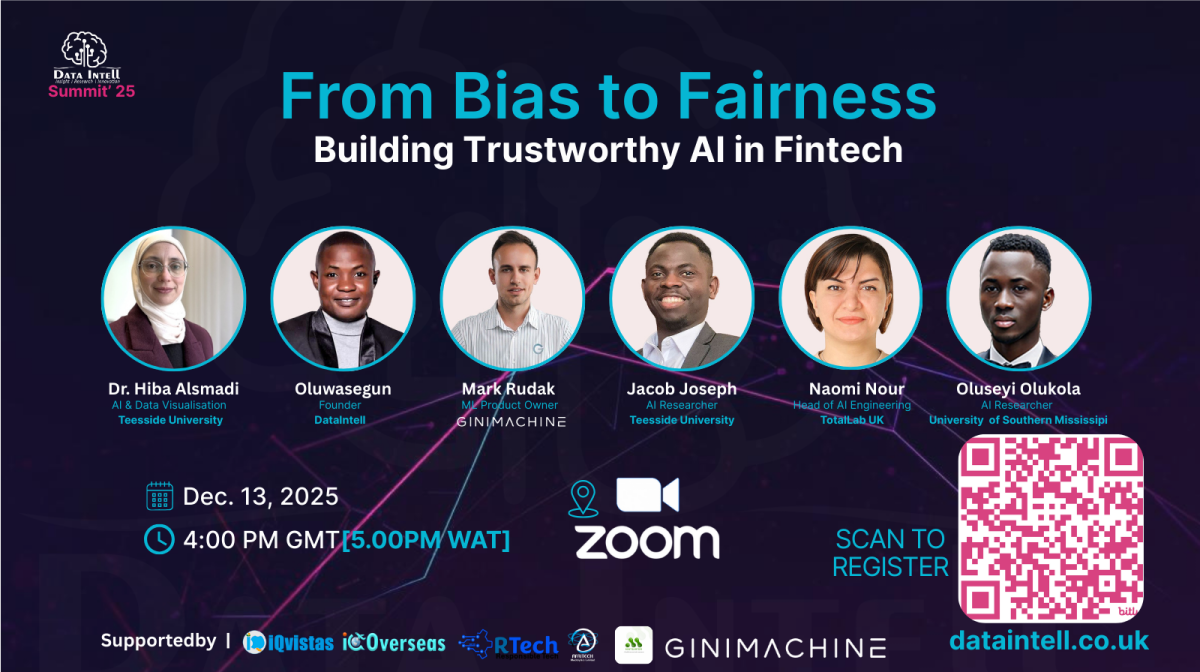
DataIntell Summit 2025: From Bias to Fairness
Quick recap
The DataIntel Resources Summit 2025 focused on building trustworthy and fair AI systems in finance, with presentations covering policy frameworks, bias detection, and transparency measures. Sessions explored various aspects of AI fairness, including explainable models, bias detection tools, and practical applications in fintech, with case studies demonstrating both challenges and successful implementations. The conversation ended with discussions on responsible deployment of Large Language Models in financial contexts, emphasizing a five-pillar framework for safe implementation and human oversight.
Summary
Fair AI Systems in Finance
The Data Intel Summit 2025 began with opening remarks from Olukola Oluseyi and Oluwasegun Odesola, who introduced the event’s focus on building trustworthy and fair AI systems in finance. Dr. Hiba Alsmadi presented on policy and regulatory frameworks for bias-free AI systems, highlighting the importance of fairness by design, transparency, accountability, and continuous monitoring. She emphasized the need for organizations to prevent bias from the outset and comply with international standards, such as the AU AI Act and FCA guidelines. The session concluded with a call for ongoing commitment to fair AI practices, as they are becoming a market differentiator and career opportunity.
Fairness and Explainability in AI
Dr. Hiba Alsmadi presented on fairness in AI, highlighting four principles: fairness by design, transparency, explainability, accountability, and continuous monitoring. She emphasized the importance of understanding how AI systems make decisions, not just what decisions they make. Joseph Jacob, a data scientist, followed up on explainable AI and interpretability, focusing on transferring these techniques from sports analytics to fintech. He discussed the increasing use of AI in fintech and the risks associated with it, including bias and lack of transparency. Joseph presented case studies on fair lending issues and explained the SHAP (SHapley Additive exPlanations) technique for making AI models more interpretable. He concluded by emphasizing the importance of fair AI and the benefits of explainable models for trust and accountability.
AI Bias Detection and Analysis
The meeting focused on AI fairness, bias, and transparency, with presentations by Joseph and Dr. Hiba discussing common sources of bias in AI systems and their practical manifestations. Joseph explained how SHAP (SHapley Additive exPlanations) tools can help identify bias sources by analyzing model predictions across different demographic groups. Mark Rudak, a machine learning product owner at HES Fintech, presented on their Gini Machine platform, demonstrating how they analyze bias metrics like Disparate Impact and Equal Opportunity Difference across different thresholds. The presentation included a case study showing bias detection in credit scoring models, particularly regarding senior citizens and gender, with Mark noting that while some biases were detected, the overall model performed well with 87% of segments passing bias tests.
LLM Deployment Framework in Finance
Naomi presented on the responsible deployment of Large Language Models (LLMs) in financial contexts, highlighting both opportunities and risks. She outlined a five-pillar framework for safe deployment: governance, fairness, transparency, security, and accountability. The framework includes measures such as forming an AI oversight committee, regular fairness audits, maintaining model transparency, and implementing robust security measures. Naomi emphasized the importance of human oversight in critical decisions and regular model retraining to adapt to changing market conditions. The session concluded with an interactive workshop where participants discussed a case study on a digital lending platform, identifying potential sources of bias and proposing mitigation strategies.
